What this website SEO check actually tests
Most SEO checkers hand you a wall of jargon and leave you to guess what matters. This check runs the same technical analysis the expensive tools run, then translates every finding into a sentence you can act on. Here's exactly what gets examined when you check a website with us:
Performance and Core Web Vitals
We measure your page's load speed using the same metrics Google uses to rank mobile results: how fast the main content renders, how quickly the page becomes interactive, and how stable the layout is while loading. Slow pages lose visitors and rankings alike — a one-second delay in load time cuts conversions measurably, so this category carries real weight in your score.
Technical SEO and crawlability
If a search engine cannot reach your pages, nothing else matters. We check indexability, redirect chains, robots configuration, broken links, and whether your URL structure is clean. These are the quiet killers: a site can look fine to a visitor while half its pages are invisible to Google.
On-page signals and structured data
Title tags, meta descriptions, heading structure and schema markup tell search engines what each page is about — and, increasingly, tell AI answer engines what to quote. We flag missing or duplicated meta tags and check whether your structured data is present and correctly formed.
Mobile usability and accessibility
Most of your visitors are on a phone, and Google indexes the mobile version of your site. We verify the layout works at phone width and check accessibility fundamentals like contrast and tap targets — issues that hurt real users today and rank you lower tomorrow.
AI search readiness
People increasingly get answers from ChatGPT, Perplexity and Google's AI Overviews instead of scrolling ten blue links. We check whether those systems can read and cite your site, so you stay visible as search shifts from links to answers. You can run the focused version on our website GEO check page.
How the SEO score works
Your website SEO score is a weighted average out of 100. Performance, technical SEO and on-page signals each contribute a substantial share, with accessibility, structured data and AI visibility making up the rest. Every issue the check finds is ranked Critical, Warning or Info, and the score falls as the critical issues add up.
The score is deliberately not a vanity number. Each point lost maps to a finding you can read, and each finding comes with a fix. That is the difference between an SEO check you look at once and one that improves your site.
Good scores versus bad scores
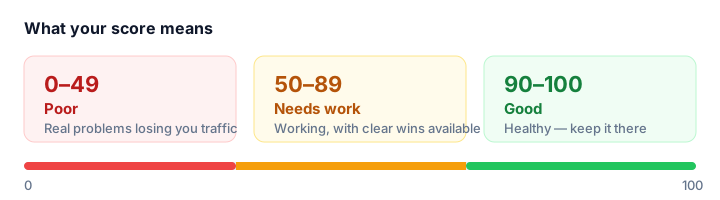
A good website SEO score — 90 or above — means your pages load quickly, search engines can index them, and your on-page signals match your content. You are not automatically on page one; you have simply removed the technical obstacles that were working against you.
A poor score is rarely one thing. It is usually a stack: oversized images slowing every page, missing meta tags, a few broken links, schema that never made it into the build. Individually each is minor; together they signal to Google that the site is unmaintained, and rankings drift down accordingly. The good news is that the fix list gives you the exact order to work through them, hardest impact first.
Why run an SEO check at all
Search traffic is the only marketing channel you do not pay for per visitor — and it compounds. The site you fix today still ranks for you next year. A regular website SEO check is how you keep that asset from quietly decaying: issues like broken links and speed regressions accumulate between checks, and they are far easier to fix early. If you are new to this, our blog post on running a complete SEO check, free, walks through the whole process step by step.
Website SEO check — questions, answered
The questions people actually ask before checking their site's SEO, answered in full so you can quote them anywhere.
- What is a website SEO check?
- A website SEO check is an automated audit that examines your site for the technical factors that affect search rankings: page speed, indexability, meta tags, structured data, mobile usability, broken links and more. It produces a health score and a list of specific problems, each with a recommended fix.
- How do I check my website's SEO score?
- Paste your website address into a free SEO checker like Site Checker and the audit runs automatically in about 30 seconds. You get a score out of 100 plus a list of issues ranked by severity, so you know exactly what is holding your site back.
- Is the website SEO check really free?
- Yes — the full scan is free with no signup and no credit card. Every category is checked, every issue is shown, and the report is yours to download as a PDF. There is no watered-down free tier.
- What does a website SEO checker analyze?
- A thorough checker analyzes page speed and Core Web Vitals, technical SEO like indexability and redirects, on-page signals like title tags and headings, mobile usability, accessibility, structured data, and whether AI search tools can read your site. Site Checker runs 40+ individual checks across these categories.
- What is a good SEO score for a website?
- On a 0–100 scale, a score of 90 or above means your site is in good health. Scores between 50 and 89 mean the site works but has clear, often quick, wins available. Below 50, there are usually real problems that are costing you search traffic.
- How long does a website SEO check take?
- Most scans complete in about 30 seconds. The tool checks your pages with Google's own performance metrics, crawls your site for technical issues, and validates structured data in parallel, so you get the full report without a long wait.
- Can I check SEO on a website I don't own?
- Yes. You can check any publicly accessible website — useful for auditing competitors or vetting sites before a purchase. The tool reads only what is publicly visible, the same way a search engine does.
- How often should I run an SEO check on my website?
- Run one after any major change — a redesign, new pages, or updated content — and at least monthly on an actively maintained site. SEO issues like broken links and speed regressions build up between checks, and catching them early is far cheaper than recovering from a rankings drop.